
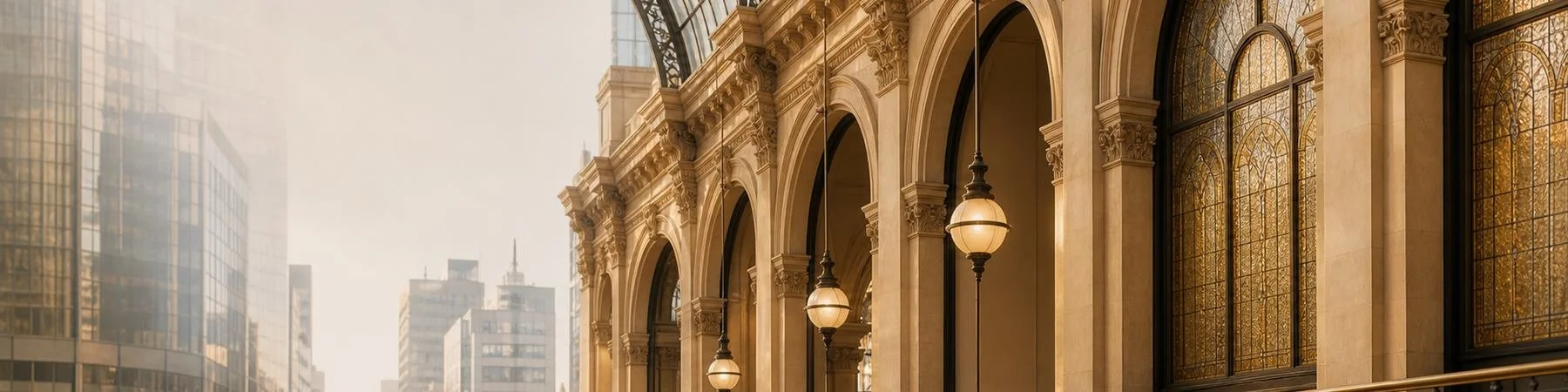
Town Hall to Wynyard: Commercial Heritage Walk
A rain-friendly CBD walk through civic buildings, cathedrals, retail interiors, theatres, bookshops, arcades, finance spaces, metro infrastructure and commercial architecture
Short Introduction
This walk treats commerce as cultural heritage. Town halls, cathedrals, arcades, theatres, bookshops, shopping towers, stations and office plazas all show how Sydney organises public life around retail, finance, transport, display and spectacle.
It is a useful route for rainy days, first CBD orientation and people who want to understand central Sydney through both historic buildings and contemporary commercial life.
Walk Snapshot
Start
Town Hall Station
Finish
Wynyard Station / Australia Square
Main Route
Town Hall Station → Sydney Town Hall → St Andrew’s Cathedral → QVB → Dymocks Building → State Theatre / Pitt Street Mall / Westfield Sydney → Strand Arcade → Martin Place / GPO / 25 Martin Place → Angel Place → Australia Square → Wynyard Station
Access Note
The route is mostly paved and central, but it includes busy crossings, indoor escalators, station entries and crowded retail or commercial spaces.
-
What to notice
Start at Town Hall Station and read Sydney Town Hall through its steps, civic facade and central position.Then look toward St Andrew’s Cathedral. Notice how civic architecture, religious architecture, transport, retail and street movement sit beside each other at one of the busiest points in the CBD.
If you want to include the newer transport layer, read Gadigal Station as part of this opening precinct rather than as a separate detour.
Why it matters
This stop sets up the route’s main argument: commercial Sydney is never only commercial.Town Hall makes civic authority visible inside a retail-heavy district. St Andrew’s Cathedral adds religious and colonial institutional presence to the same urban space. Town Hall Station and Gadigal Station add transport layers that show how movement continues to reshape this part of the city.
Together, they show how public life, ceremony, religion, movement and commerce overlap in central Sydney.
Question to carry
How do civic, religious, retail and transport spaces compete for attention in the commercial city? -
What to notice
Enter QVB and read the dome, galleries, clocks, stairs, tiles and interior promenade.Look up as well as across. The building is designed for looking, moving and lingering.
Why it matters
QVB shows how a heritage building can become a high-value retail interior. It is both preservation and consumption.The building helps visitors understand that heritage can be loved, used and commercialised at the same time.
Question to carry
When does heritage become a shopping experience? -
What to notice
Move north to the Dymocks Building on George Street. Read the facade, retail entries, upper floors and the idea of a multi-level commercial building.Notice how a bookshop name can become part of a building’s identity and a city’s memory.
Why it matters
The Dymocks Building strengthens the route’s commercial heritage layer. It connects bookselling, retail optimism, office space and George Street’s long history as a shopping and business corridor.This stop is useful because commercial heritage is not only about grand arcades or luxury interiors. It can also be held in everyday retail names, shopfronts and multi-storey buildings.
Question to carry
How can a shop become part of a city’s memory? -
What to notice
Turn toward State Theatre, Pitt Street Mall and Westfield Sydney. Read the theatre facade, vertical sign, pedestrian crowds, retail entrances, tower, escalators, food floors and branded interiors.Notice how entertainment, shopping and vertical retail sit close together.
Why it matters
This stop brings together theatre culture and contemporary retail spectacle.State Theatre adds entertainment history to the commercial route. Pitt Street Mall and Westfield Sydney show how shopping has moved into a dense vertical system of malls, towers, escalators and branded interiors. Sydney Tower changes how the commercial city is seen from above, while Westfield changes how it is navigated from inside.
Together, they show that commercial culture is not only about buying. It is also about performance, display, height, movement and public attention.
Question to carry
How do theatre, vertical shopping and spectacle reshape the CBD? -
What to notice
Enter the Strand Arcade and read the glass roof, timber shopfronts, cast iron detail, upper galleries and narrow promenade.Walk slowly. The arcade is about rhythm, looking and display.
Why it matters
The Strand Arcade is one of Sydney’s strongest surviving Victorian retail interiors. It preserves an older form of commercial walking, where shopping, display and promenade merge.This is one of the strongest stops on the route because the building itself teaches you how earlier retail culture wanted people to move.
It also works well as a route connector: from the Pitt Street retail core, it helps move the walk back toward George Street and Martin Place without unnecessary backtracking.
Question to carry
How does an arcade choreograph looking and walking? -
What to notice
Continue toward Martin Place. Read the GPO, pedestrian mall, financial buildings, metro entries and the surrounding commercial architecture.Look also at 25 Martin Place as part of this commercial and cultural cluster: theatre, office life, luxury retail, food and modernist architecture all sit within the symbolic financial core of the city.
Stand still for a moment and read Martin Place as an urban room. Watch how office workers, visitors, shoppers, commuters and event crowds move through the space.
Why it matters
Martin Place turns commerce into civic space. Postal history, finance, memorials, rail infrastructure, retail and corporate architecture all share one public setting.25 Martin Place adds another layer: modernist commercial architecture, theatre, luxury retail and office life sitting inside the symbolic financial core of the city.
Question to carry
How does a financial district become a civic stage? -
What to notice
Move toward Angel Place and look up. Read the suspended birdcages, sound, narrow laneway scale and contrast with the surrounding commercial buildings.Pause for a moment and listen, rather than only looking.
Why it matters
Forgotten Songs adds a quieter layer to the commercial city. It recalls bird species once heard in central Sydney before urban development changed the local soundscape.This stop is important because it prevents the walk from becoming only about buildings, retail and finance. It shows that a commercial district also contains memory, loss, public art and traces of the natural world.
Placed between Martin Place and Australia Square, Angel Place works as a strong interpretive transition: from finance and civic space into laneway memory and modern commercial architecture.
Question to carry
What kinds of memory can survive in a commercial laneway? -
What to notice
Move north-west toward Australia Square. Notice the relationship between tower, open space, public art, office life, food and pedestrian movement.Read the plaza as carefully as the tower. It is not only a building, but a designed commercial public space.
Why it matters
Australia Square represents modernist commercial Sydney: tower, plaza, art, office culture and urban ambition.It shows how commercial architecture changed from street-front retail and arcades into vertical office space and open plazas.
Question to carry
How did modernism change Sydney’s commercial skyline? -
What to notice
Finish at Wynyard Station. Notice the commuter flows, office workers, underground passages, retail connections and the way the station feeds the northern CBD.Look back at the route as a movement from civic centre to office city.
Why it matters
Ending at Wynyard brings the route back to transport and everyday working life.The walk begins with Town Hall’s civic-commercial centre and ends with the office city feeding into the station. This final stop reminds visitors that commercial heritage is not only preserved in beautiful buildings. It is also lived through daily movement, commuting, shopping, working and passing through.
Question to carry
How does everyday movement keep the commercial city alive?
Before You Begin
This route is located on Gadigal Country.
The walk moves through the commercial heart of Sydney’s CBD. It is easy to treat these spaces as shopping streets, office towers or transport corridors only, but they also hold civic, religious, commercial, entertainment and architectural memory.
This route does not separate “heritage” from “shopping”. It asks how commercial spaces, civic buildings, religious institutions, transport infrastructure, public art and retail interiors together shape public culture.
Why This Walk Matters
Central Sydney is not only a place of offices and shops. It is a cultural landscape built through commerce, movement, ceremony, spectacle and display.
In a short walk from Town Hall to Wynyard, you pass buildings and interiors where commerce, civic authority, religion, entertainment, transport, public art and finance overlap. QVB, Dymocks Building and Strand Arcade show commercial heritage directly, while Town Hall, St Andrew’s Cathedral, Martin Place, Angel Place, Australia Square and Wynyard show how public life is organised around the commercial city.
This route is deliberately practical. It works when the weather is bad, starts and ends at major stations, and gives visitors many indoor or covered pauses.
The larger question is simple: how does a commercial city become a cultural heritage landscape?
Route Logic and Interpretive Structure
This walk runs from Town Hall to Wynyard using the shortest practical sequence through Sydney’s civic, retail, theatre, arcade, finance and transport spaces.
Town Hall Station → St Andrew’s Cathedral → QVB → Dymocks Building → State Theatre / Pitt Street Mall / Westfield Sydney → Strand Arcade → Martin Place / GPO / 25 Martin Place → Angel Place / Forgotten Songs → Australia Square → Wynyard.
The route is organised as a series of close reading clusters rather than a strict straight line. It reads the CBD as a commercial heritage landscape, where shopping, civic authority, religion, theatre, bookselling, arcades, public art, finance and transport all shape public life.
This structure reduces unnecessary backtracking while keeping each stop close to the next.
STOPS
Access and Planning Notes
This walk is designed as a cultural reading route rather than a shopping itinerary.
Public pause points may be available around QVB, Westfield Sydney, Strand Arcade, Martin Place, 25 Martin Place, Australia Square and Wynyard, depending on opening hours and access conditions.
For a slower version, use QVB, Strand Arcade, Martin Place or Australia Square as the main pause point. Check current access information before relying on interior routes, lifts, escalators, arcades, station entries or commercial building access.
Suggested Sources and Further Reading