
Museum to Macquarie: Public Culture Walk
A high-density cultural walk from Museum Station to Circular Quay via Hyde Park, Macquarie Street and the Royal Botanic Garden
Short Introduction
This walk reads central Sydney as a civic landscape rather than a sequence of tourist landmarks. Beginning at Museum Station and moving through Hyde Park, Macquarie Street and the Royal Botanic Garden, the route connects war memory, natural history, Catholic architecture, public art, convict administration, colonial medicine, parliament, public knowledge, botanical science and harbour identity.
By “public culture”, this guide refers to the museums, memorials, libraries, religious buildings, hospitals, gardens and government spaces through which a city tells stories about itself.
Walk Snapshot
Start
Museum Station / ANZAC Memorial
Finish
Royal Botanic Garden / Circular Quay
Distance
Approx. 3.8–5 km, depending on optional stops
Access Note
Mostly paved city paths, with some crossings, slopes, stairs or uneven surfaces depending on building entries and garden path
-
What to notice
Start at Museum Station, one of the early underground stations on Sydney’s City Circle. Before walking north, notice how the station places you directly at the southern edge of Hyde Park, close to both the Australian Museum and the ANZAC Memorial.At the ANZAC Memorial, look at the Art Deco form, the Pool of Reflection, the symmetry of the building and the way it sits within Hyde Park rather than outside it.
Why it matters
Opened in 1934, the ANZAC Memorial is one of Sydney’s most important spaces of public remembrance. It frames war memory as a civic and national ritual, using architecture, sculpture, water and open space to guide how visitors pause, look and remember.Question to carry
How does architecture create collective memory? -
What to notice
Walk east to the Australian Museum. Compare the older facade, the entrance sequence and the relationship between historic fabric and contemporary additions.Notice how the museum sits near Hyde Park, St Mary’s Cathedral and the city, rather than in a separate museum district.
Why it matters
The Australian Museum is not just a place of specimens. It shows how a city collects, classifies and presents nature, science and culture.It also opens questions about colonial knowledge, public education and the authority of museums to organise the world into displays. Read together with the State Library later in the route, the Australian Museum becomes part of a larger public knowledge network.
Question to carry
Who has the authority to collect and classify nature and culture? -
What to notice
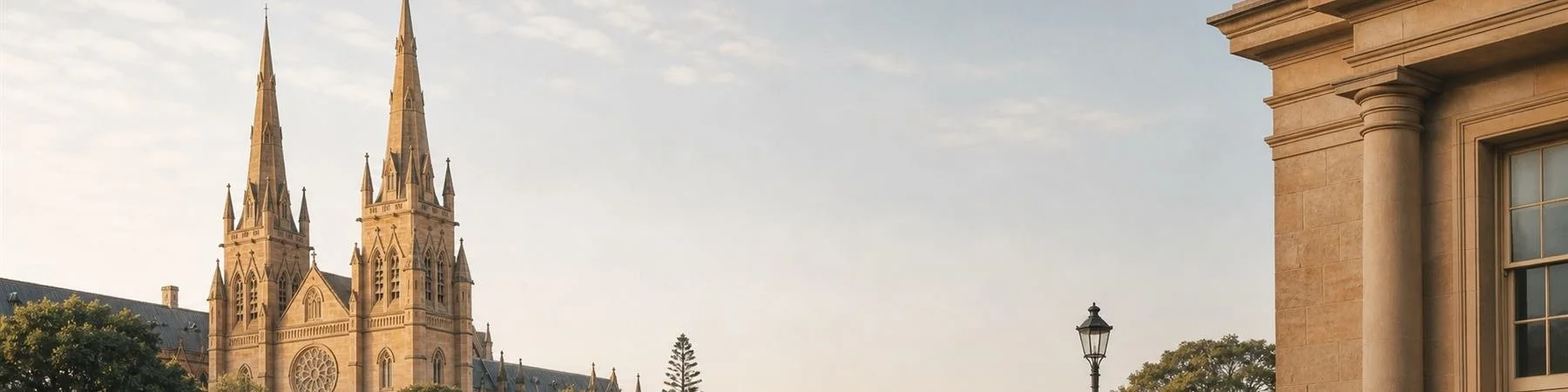
Stand back on the Hyde Park side first for the full facade, then move closer to read the sandstone, twin spires, rose window and entry scale.Look at how the cathedral relates to Hyde Park, the Australian Museum and the public space around it.
Why it matters
St Mary’s Cathedral links Catholic presence, Gothic Revival architecture, sandstone craft and the public view corridor of Hyde Park. It is best read as part of the city’s civic landscape, not as an isolated church.The cathedral also shows how religion becomes visible through architecture, ceremony and urban position.
Question to carry
How does religion become visible in civic space? -
What to notice
Walk into the centre of Hyde Park. This is one of the best visual reading points on the route: fountain in the foreground, cathedral and park behind it, city buildings around it.Notice the figures, water movement, circular form and the way people naturally pause around the fountain.
Why it matters
Unveiled in 1932, Archibald Fountain commemorates the relationship between Australia and France during World War I. It turns Hyde Park into a civic room, combining mythology, memorial language, public art and urban leisure.This stop helps show that public memory is not always solemn. Sometimes it is embedded in a place where people sit, meet, take photos and pass through.
Question to carry
How do mythology, war memory and leisure share one public space? -
What to notice
Before entering, stand outside the courtyard and read the building as an enclosed system: sandstone walls, controlled entry point, open yard and restrained geometry.Look at how different it feels from the cathedral, fountain and park.
Why it matters
Built between 1817 and 1819 and designed by Francis Greenway, Hyde Park Barracks was originally constructed to house male convicts. It is now part of the Australian Convict Sites World Heritage property, which recognises the larger history of convict transportation and forced labour in colonial Australia.The site later carried other institutional lives, including its use as a female asylum and reception place for assisted female immigrants. This makes the Barracks more than a convict building. It is a site where control, labour, migration, gender and colonial administration can be read through one place.
The site is important not only because it is old, but because it makes systems of authority, punishment, care, labour and administration physically visible.
Question to carry
How can a building make authority visible? -
What to notice
The Mint sits directly next to Hyde Park Barracks. Look at the sandstone, verandahs, courtyard and quieter scale of the site.Notice how close it is to the Barracks and how the two buildings form part of a larger Macquarie Street institutional landscape.
Why it matters
Originally part of the Rum Hospital, The Mint later became a branch of the Royal Mint. It shows how one site can move through hospital, mint, government office and cultural use.This is one of the strengths of Macquarie Street: the buildings do not only represent one period or one function. They carry layers of changing public purpose.
Question to carry
How can one building move from medicine to money to heritage? -
What to notice
Continue north to Sydney Hospital. Notice the long frontage, courtyard entrance and the Il Porcellino boar sculpture near the entrance.The boar is an easy and friendly pause point, but do not let it distract from the hospital’s longer institutional history.
Why it matters
Sydney Hospital continues Macquarie Street’s medical history. This is where institutional history meets everyday ritual and public touch: the boar sculpture invites touch, luck and photography, while the hospital points to care, illness and civic infrastructure.It is a useful stop because it keeps the route from becoming only about grand buildings. Public culture also includes bodies, health, vulnerability and care.
Question to carry
What does public health reveal about colonial and civic infrastructure? -
What to notice
Read Parliament House through its position, not its height. It is visually modest, but institutionally crucial.Notice how close it is to Sydney Hospital, The Mint, Hyde Park Barracks and the State Library.
Why it matters
NSW Parliament occupies part of the former Rum Hospital complex. Its significance comes less from visual grandeur and more from institutional continuity, adaptation and civic function.This stop is useful because it challenges the assumption that important public buildings must always look monumental. In Sydney, power can sometimes appear in modest sandstone form.
Question to carry
Why are some powerful institutions visually modest? -
What to notice
Walk north to the State Library of New South Wales. Start with the Mitchell Library facade, then go inside if time allows.Look for the reading rooms, exhibition spaces, stone exterior and the relationship between quiet study and public access.
Why it matters
The State Library represents the preservation of public knowledge. Read together with the Australian Museum, it completes an important knowledge pair: the museum collects and interprets objects and specimens, while the library preserves documents, images, maps, books and stories.This is also a good pause point. If you only go inside one building on this walk, the State Library is one of the strongest choices.
Question to carry
How does a city preserve its memory? -
What to notice
If you want a longer museum-focused version, walk from the State Library toward the Art Gallery of New South Wales before entering the Royal Botanic Garden.For a short version, read the exterior, entry sequence and relationship between the gallery, the Domain and the garden. If you have time, go inside and treat this as a half-day version of the route.
Why it matters
The Gallery extends the route from public institutions and scientific collections into visual art, Aboriginal art, contemporary exhibitions and museum architecture.It is best treated as optional because it changes the rhythm of the walk. Without it, the route stays compact and civic. With it, the walk becomes a broader cultural precinct route.
Question to carry
How does an art museum change the route from civic history into cultural interpretation? -
What to notice
Enter the Royal Botanic Garden and let the route shift from public buildings into landscape, shade, plants and harbour views.Notice how the pace changes as soon as you leave the street corridor.
Why it matters
Established in 1816, the Royal Botanic Garden is tied to plant science, colonial collecting, experimentation and leisure. It is a deliberate shift in spatial experience: science, empire, plants and harbour identity occupy the same landscape.This stop also softens the route. After a line of institutions, the garden allows the walk to breathe.
Question to carry
How do science, empire, plants and leisure occupy the same landscape? -
What to notice
Finish by walking from the garden toward Circular Quay. The route opens naturally from parkland to the harbour, ferries and transport connections.Notice the change from underground station to memorial, museum, cathedral, fountain, institutions, library, garden and harbour. From this end point, the Sydney Opera House may also enter the view as part of the harbour’s World Heritage architectural landscape, but it is not treated as a separate stop on this route.
Why it matters
The ending gives the walk a clear spatial arc. It begins in the city grid and ends at the harbour, moving through many of the places where Sydney tells official and public stories about itself.Circular Quay brings together transport, harbour spectacle, civic arrival and international recognition. It also frames the Opera House, a World Heritage-listed work of twentieth-century architecture, as part of the wider public image of Sydney.
Question to carry
How does the harbour change the way a city remembers and represents itself?
Before You Begin
This route is located on Gadigal Country.
This walk focuses mainly on colonial and civic institutions. These places stand within a much older and continuing Aboriginal cultural landscape, and this route should be read alongside First Nations-led interpretation wherever possible.
Why This Walk Matters
This route is one of the most culturally dense walks in central Sydney. In a short distance, it links many of the institutions through which Sydney has organised memory, authority, religion, science, medicine, law, knowledge and landscape.
The route begins at a transport threshold, moves through memorial and museum space, enters the civic corridor of Macquarie Street, then opens into the Royal Botanic Garden and the harbour. Its value is not only the number of well-known sites, but the way those sites sit close together and speak to each other.
This is not a route about seeing everything. It is a route about learning how to read a city through public buildings, institutional memory, landscape and everyday walking.
Route Logic and Interpretive Structure
This walk moves from Museum Station through Hyde Park and Macquarie Street, then opens into the Royal Botanic Garden and Circular Quay.
Museum Station → ANZAC Memorial → Australian Museum → St Mary’s Cathedral → Archibald Fountain → Hyde Park Barracks → The Mint → Sydney Hospital → Parliament House → State Library → Royal Botanic Garden → Circular Quay.
The route is organised around three interpretive layers: public memory, civic institutions and landscape / harbour identity.
Hyde Park introduces war memory, natural history, religion and public art. Macquarie Street forms the civic corridor of convict administration, medicine, parliament and public knowledge. The Royal Botanic Garden and Circular Quay shift the walk from institutions into landscape, science, leisure and harbour identity.
The Art Gallery of New South Wales can be added after the State Library as an optional extension for a longer museum-focused version of the walk.
STOPS
Access and Planning Notes
This walk is designed as a cultural reading route rather than a complete visitor itinerary.
Public pause points may be available at the Australian Museum, State Library of New South Wales, Royal Botanic Garden and Circular Quay, depending on opening hours and access conditions.
For a slower version, use the State Library or Royal Botanic Garden as the main pause point. Check official websites before relying on interior visits, exhibitions, facilities or access routes.
Suggested Sources and Further Reading
Australian Museum
https://australian.museum/ANZAC Memorial
https://www.anzacmemorial.nsw.gov.au/Hyde Park Barracks
https://mhnsw.au/visit-us/hyde-park-barracks/Sydney Hospital
https://www.seslhd.health.nsw.gov.au/sydney-hospital-and-sydney-eye-hospitalParliament of New South Wales
https://www.parliament.nsw.gov.au/State Library of New South Wales
https://www.sl.nsw.gov.au/Royal Botanic Garden Sydney
https://www.botanicgardens.org.au/royal-botanic-garden-sydneyArt Gallery of New South Wales
https://www.artgallery.nsw.gov.au/